By Adán de Salas Quiroga

Adán de Salas Quiroga is a neurobiologist who specialises in the science of cannabis and the endocannabinoid system, with more than ten years' research experience. He has studied the therapeutic properties of cannabis and its mechanisms of action in various clinical conditions, acquiring extensive experience in multiple biomedical aspects related to cannabinoids. He has worked in several research centres and his work has resulted in numerous articles in high-impact scientific journals, a book chapter and dozens of presentations at national and international conferences.
Currently, Adán provides high quality independent training for health professionals and offers R&D consultancy to companies in the field of medical cannabis. Within this framework, and together with Brazilian neurosurgeon Patricia Montagner, he is co-author of the Treatise on Endocannabinoid Medicine, the largest compendium available to date on the clinical evidence for the medical use of cannabis. He is also the scientific coordinator of the WeCann Summit, considered the largest medical cannabis congress in the world, which brings together nearly 1,500 doctors from different disciplines and countries every year in Brazil.
Adán holds a degree in Biology and a Master's and PhD in Biochemistry, Molecular Biology and Biomedicine from the Complutense University of Madrid.
In October 2025, Spain approved Royal Decree 903/2025, which establishes for the first time a specific regulatory framework for the prescription of standardized cannabis preparations1. This milestone has inevitably intensified the media noise surrounding the issue. Headlines like "Cannabis destroys the brains of young people" or "Cannabis cures cancer according to a new study" have been circulating for decades, but the new regulatory context has multiplied them. Both extremes are equally harmful: alarmism hinders access for those who could benefit; uncritical enthusiasm generates false expectations and can lead to inappropriate clinical decisions.
This problem is not unique to cannabis. In other areas it is common to read headlines like "New hope against Alzheimer's" when discussing research in animal models that can take decades to translate into real benefits — if it ever does. But there is an added ideological bias in this field that further complicates the impartial reading of the evidence. In this article we will explore a tool for navigating that ocean: critical thinking applied to scientific reading. And for that, it is essential to understand what types of studies exist and what we can—and cannot—derive from each one.
How to navigate the ocean of information
Given this scenario, the first step is to learn to distinguish between sources. Scientific journals, medical societies and regulatory bodies — such as the AEMPS or the EMA — submit their contents to evaluation processes that, although imperfect, offer minimum guarantees of rigor. Blogs, press releases, or social media, on the other hand, require by default a critical attitude. They can be useful for dissemination, but they rarely offer the necessary context to assess the quality of the evidence.
For those who wish to consult primary sources, PubMed is the leading database of scientific literature. However, it has limited search tools and as of today the term 'cannabinoids' yields more than 40,000 results. Navigating that volume without any criteria is as overwhelming as it is futile.
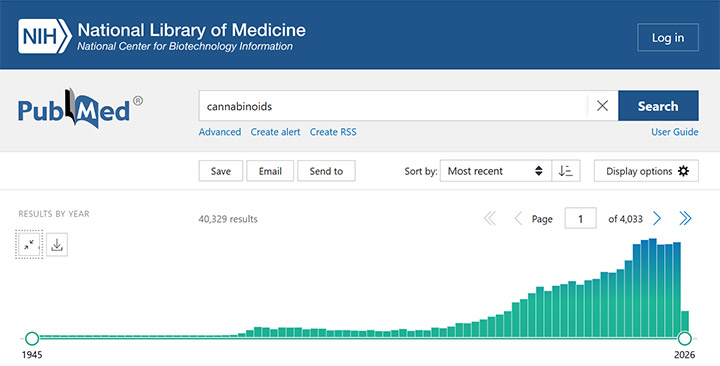
Screenshot from the PubMed scientific literature search engine, showing the evolution of cannabinoid research, yielding more than 40,000 results in 2026.
If we want to evaluate the quality of a scientific article, we must start from the Methodology section. This describes the design, sample size, inclusion and exclusion criteria, type of blinding, and statistical analysis used in the study. The Abstract offers a first approximation, but it can be misleading if it is not read alongside the rest of the article and, especially, the Discussion, where honest authors acknowledge the limitations of their conclusions.
The pyramid of biomedical evidence
Not all scientific evidence carries the same weight. The most intuitive way to understand this is through the evidence pyramid, which ranks study types according to their methodological soundness.
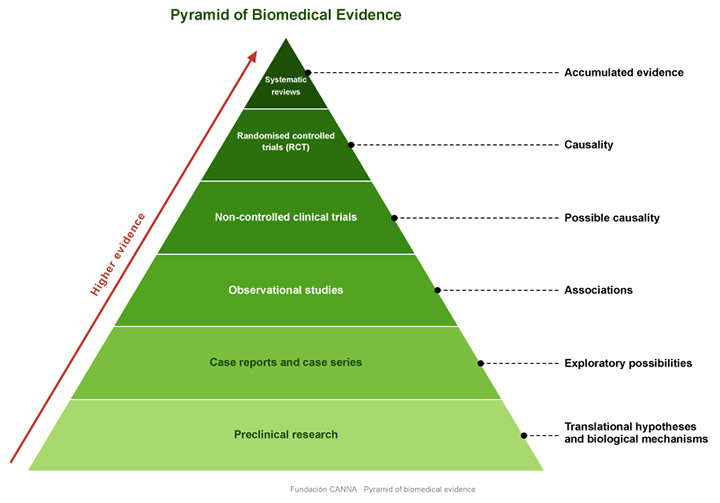
Graphic representation of the biomedical evidence pyramid, showing the different types of scientific studies in increasing degrees of evidence, as well as the type of information that can be inferred from each of these publications.
At the base of the pyramid, preclinical research — cell cultures or animal models — generates translational hypotheses with prospective value, but above all allows for a deeper understanding of the biological mechanisms involved. It is the starting point for almost all research, but the furthest removed from clinical application in humans.
On the second step we find the case reports and case series: descriptions of one or a few patients that document effects observed in clinical practice. Its value lies in providing exploratory clinical possibilities, but without any possibility for generalization.
Then we found observational studies, where there is no direct intervention on participants, who are simply observed and compared. These allow us to identify correlations between variables, but we must be cautious when trying to establish causal relationships, as there are too many uncontrolled variables. However, under rigorous methodological conditions and with large samples, they offer clinical information of enormous value.
Above them are the uncontrolled clinical trials: these are studies in which a treatment is administered without a control group and knowing the treatment received, which reduces the ability to attribute the observed effects exclusively to the intervention.
On the penultimate step are randomized controlled clinical trials (RCTs), considered the gold standard for establishing causal relationships. Participants are randomly assigned to the experimental group or the control group —usually placebo— in a 'double-blind' manner, with neither the patient nor the researcher knowing who receives what, to avoid possible biases.
Finally, at the very top are systematic reviews and meta-analyses. These publications synthesize the results of multiple studies on the same clinical question, applying strict methodological criteria to select and analyze them. When done well, they offer the most complete and least biased view of the state of the evidence.
The classic pyramid is complemented today by other approaches. Real-world evidence (RWE) groups together large-scale, prospective, and systematic observational studies designed to capture real-world clinical practice with sufficient methodological robustness to influence regulatory decisions. In the case of cannabis, close examples include the UK Medical Cannabis Registry2 —with data from approximately 15,000 patients, although with funding biases that should be taken into account— and the T21 Project3, conducted by the non-profit organization DrugScience, with around 4,500 registered patients.
There are also the evidence maps: tools that systematize and visualize the available evidence from systematic reviews classified by their quality and results, generating what could be called meta-evidence4.
Are RCTs really the gold standard?
The role given to RCTs as the sole arbiter of scientific truth deserves critical reflection. Their intrinsic strength—the ability to establish causality—comes with a significant extrinsic weakness. Their strict inclusion and exclusion criteria, experimental design, and high cost make them studies with generally small and very homogeneous samples from a clinical and demographic point of view. The result is high internal validity but limited applicability outside the study: the real patient population is much more heterogeneous than that of any RCT.
In the specific case of cannabis, this limitation is compounded by additional methodological problems. Participants who receive products containing THC often recognize it by its psychotropic effects, which compromises the integrity of the blinding. Added to this is the great intra- and interpersonal variability in sensitivity to cannabinoids—making personalized doses necessary, which are difficult to standardize—and the fact that the endocannabinoid system participates in the regulation of the placebo responses themselves 5,6, which introduces confounding variables that are difficult to control.
In addition to these methodological barriers, there is a structural difficulty: THC is an internationally controlled substance, which means that any research—even preclinical research—requires specific authorizations from regulatory bodies that can take months or more than a year. This extra bureaucratic burden does not exist for new drugs or uncontrolled substances, and it represents a significant obstacle to the progress of research in this field.
In this context, methodologically sound observational studies are an essential complement, not an inferior substitute. Schlag et al. (2022) argue precisely that registries like T21 allow generating evidence on thousands of patients with diverse clinical characteristics, providing an extrinsic validity that no RCT can offer7.
Biases that condition the evidence
Methodological, economic, and even psychological factors influence what is studied, how it is studied, and how the results are communicated. Knowing the most common biases is an essential part of critical thinking.
- Publication bias. Studies with positive or statistically significant results are more likely to be published than those with null or negative results. This distorts the overall picture of the evidence, as failures remain hidden in researchers' drawer.
- Selection bias. This occurs when the study sample is not representative of the population to which the results are intended to be extrapolated, as can happen in the RCTs mentioned earlier.
- Funding bias. The source of funding influences not only the questions asked, but also the design of the study and the conclusions. In the field of cannabis, this bias operates in both directions. An article published in The Lancet showed that the three largest funders of cannabis research in the United States are institutions specializing in addiction or mental health, creating a structural imbalance towards the documentation of risks.8. Conversely, when the sponsor is a company with a direct interest in demonstrating effectiveness, the risk lies in favorable designs, inadequate comparators, or conclusions that go beyond what the data supports. This does not imply that all industry-funded research is fraudulent —it is often the only way to fund expensive RCTs— but it does require reviewing potential conflicts of interest.
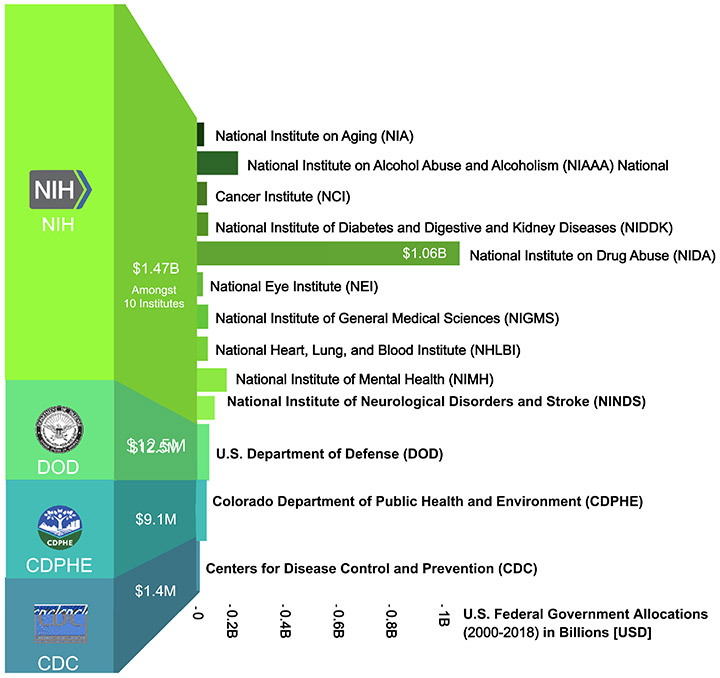
Figure taken from Purcell JM, Passley, TM, & Leheste, JR (2022). The Lancet Regional Health – Americas, 14, 100325. CC BY-NC-ND 4.0. - Confirmation bias and spin bias.
Both researchers and readers tend to seek, interpret, and remember what confirms our previous beliefs, ignoring what contradicts them. This cognitive bias influences how a study is designed, which variables are prioritized, and how the results are interpreted. The writing and communication phase gives rise to spin bias: the tendency to present findings as more favorable or conclusive than the data actually support. The opposite has also been documented in cannabis literature: reverse spin bias where the authors minimize or ignore statistically significant positive results from their own data. A recent study found this pattern in 10 of 29 systematic reviews on the use of cannabis for pain, through mechanisms such as rating the evidence as "inconsistent" without methodological justification or introducing references to unassessed risks to deflect attention from the benefits.9.
Statistical significance vs. clinical relevance
Un resultado puede ser estadísticamente significativo (p < 0,05) y ser, al mismo tiempo, clínicamente irrelevante. Imaginemos un estudio con 5.000 participantes que detecta una reducción de 0,2 puntos en una escala de dolor de 10 puntos. La muestra grande permite un resultado estadísticamente significativo, pero una mejoría de esa magnitud difícilmente cambia la calidad de vida de un paciente.
La relevancia clínica debe siempre acompañar a la evaluación estadística. Del mismo modo, conviene no descartar estudios con resultados no significativos que muestran una tendencia: son información valiosa para diseñar investigaciones futuras. Los estudios que declaran abiertamente sus limitaciones, que publican resultados negativos y que son moderados en sus conclusiones merecen mayor confianza, no menor. La honestidad metodológica es un signo de calidad científica.
One special precaution: preclinical research
Translating results from animal models or cell experiments into clinical practice is a long process with a high failure rate: several studies suggest that more than 90% of drugs that are effective in animal models do not make it through clinical trials10,11.
A close example is the antitumoral potential of cannabinoids, a topic about which misinformation abounds. Manuel Guzmán, from the Complutense University of Madrid, has been leading preclinical research on this topic for decades. His findings are promising in animal models, but as he himself states: "Today we know that cannabinoids can help mice overcome cancer, but not humans.". To date, only a handful of clinical trials on this topic have been completed, and only one of them meets the criteria for an RCT, with results that its own authors described as inconclusive12.
The reasons for this translational gap are multiple—limitations of the models, pathophysiological, immunological or pharmacodynamic differences—and explain why what works in a mouse may be ineffective or even counterproductive in a human. Hence the importance of interpreting any preclinical result with caution, however promising it may seem.
Tips for the critical reader
The best tool for navigating this ocean of information is not scientific knowledge, but cultivating critical thinking: evaluating study design, sample size, potential biases, and stated limitations; avoiding extreme positions, since both denialism and uncritical enthusiasm are equally counterproductive; and understanding that science is not a set of immutable truths, but a collective and demanding process that advances through the accumulation and constant review of evidence.
Regarding the medical use of cannabis, the evidence is heterogeneous: strong for some indications, still scarce for others. But there is one area of remarkable consistency: treatments with standardized products under professional supervision have demonstrated a favorable safety profile, superior even to that of many conventional drugs. Supporting and promoting research is a collective responsibility, and for this reason I am calling for greater awareness as a society and urge regulatory bodies to relax the requirements that currently hinder research with these compounds. Not because of ideology, but because doing so is the only way to generate the evidence that patients need and deserve.
References
1. Real Decreto 903/2025, de 7 de octubre, por el que se establecen las condiciones para la elaboración y dispensación de fórmulas magistrales tipificadas de preparados estandarizados de cannabis. (2025). Boletín Oficial del Estado, 242. https://www.boe.es/diario_boe/txt.php?id=BOE-A-2025-20077
2. Curaleaf Clinic. (s.f.). UK Medical Cannabis Registry. Recuperado el 9 de abril de 2026, de https://ukmedicalcannabisregistry.com/
3. Drug Science. (s.f.). T21 (formerly Project Twenty21). Recuperado el 9 de abril de 2026, de https://www.drugscience.org.uk/t21
4. Montagner, P., de Salas Quiroga, A., Ferreira, A. S., Duarte da Luz, B. M., Ruppelt, B. M., Schlechta Portella, C. F., Abdala, C. V. M., Tabach, R., Ghelman, R., Blesching, U., Perfeito, J. P. S., & Schveitzer, M. C. (2024). Charting the therapeutic landscape: A comprehensive evidence map on medical cannabis for health outcomes. Frontiers in Pharmacology, 15, 1494492. https://doi.org/10.3389/fphar.2024.1494492
5. Benedetti, F., Amanzio, M., Rosato, R., & Blanchard, C. (2011). Nonopioid placebo analgesia is mediated by CB1 cannabinoid receptors. Nature Medicine, 17, 1228–1230. https://doi.org/10.1038/nm.2435
6. Tomin, R., Murray, K., Hadjis, G. E., Khalil, O., Sexton, C., Bourke, S. L., Khan, J. S., Finn, D. P., Atlas, L. Y., & Moayedi, M. (2026). The endocannabinoid system's contribution to placebo analgesia [Preprint]. bioRxiv. https://doi.org/10.64898/2026.02.25.707676
7. Schlag, A. K., Zafar, R. R., Lynskey, M. T., Athanasiou-Fragkouli, A., Phillips, L. D., & Nutt, D. J. (2022). The value of real world evidence: The case of medical cannabis. Frontiers in Psychiatry, 13, 1027159. https://doi.org/10.3389/fpsyt.2022.1027159
8. Purcell J. M., Passley, T. M., & Leheste, J. R. (2022). The cannabidiol and marijuana research expansion act: Promotion of scientific knowledge to prevent a national health crisis. The Lancet Regional Health – Americas, 14, 100325. https://doi.org/10.1016/j.lana.2022.100325
9. O'Leary, R., La Rosa, G. R. M., & Polosa, R. (2026). Reverse spin bias: Preliminary observations of reporting bias in medical systematic reviews. Research Integrity and Peer Review, 11, 1. https://doi.org/10.1186/s41073-025-00185-9
10. Mak, I. W., Evaniew, N., & Ghert, M. (2014). Lost in translation: Animal models and clinical trials in cancer treatment. American Journal of Translational Research, 6(2), 114–118. https://www.ncbi.nlm.nih.gov/pmc/articles/PMC3902221/
11. Marshall, L. J., Bailey, J., Cassotta, M., Herrmann, K., & Pistollato, F. (2023). Poor translatability of biomedical research using animals — A narrative review. Alternatives to Laboratory Animals, 51(2), 102–135. https://doi.org/10.1177/02611929231157756
12. Twelves, C., Sabel, M., Checketts, D., Miller, S., Tayo, B., Jove, M., Brazil, L., & Short, S. C. (2021). A phase 1b randomised, placebo-controlled trial of nabiximols cannabinoid oromucosal spray with temozolomide in patients with recurrent glioblastoma. British Journal of Cancer, 124(8), 1379–1387. https://doi.org/10.1038/s41416-021-01259-3