By Mariano Garcia de Palau

Born in Barcelona, 17 February 1956. Graduated in medicine and surgery from the University of Barcelona in 1979. For 38 years has worked as an emergency physician in the area of occupational medicine. He became interested in cannabis by chance, and for the last 15 years has studied its therapeutic uses.
Currently he continues to advise on cannabinoid treatments and performs clinical work with patients, collaborates with various organizations and associations, serves as Senior Consultant for Grupo Curativa Colombia and is a spokesperson for the Spanish Medical Cannabis Observatory.
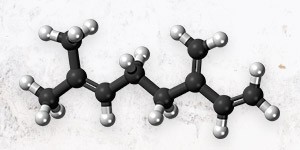
Terpenes are the most abundant group of molecules in nature, with about 20,000-30,000 different compounds. The basic structure is isoprene, a hydrocarbon (compound of carbon and hydrogen) with 5 carbon atoms. In cultivars (cultivated strains) of cannabis about 200 different terpenes are described. When it comes to terpenes present in the different cultivars of cannabis, we are especially interested in monoterpenes (with 10 carbon atoms) and sesquiterpenes (with 15 carbon atoms), which are responsible for the smell and taste of most plants. In the case of cannabis we should also consider flavonoids and the volatile sulphur compounds of some cultivars that provide exotic flavours and smells.
Monoterpenes and sesquiterpenes are synthesised in glandular trichomes, complex structures common to many botanical species: monoterpenes are synthesised in flowers, and sesquiterpenes in leaf structures.
That is why we always recommend using flowers and leaves in different quantities for whole plant extractions. Some monoterpenes, such as myrcene, limonene, linalool, pinene, eucalyptol, citral, geraniol, to mention a few, are more abundant in different cultivars. As for sesquiterpenes, betacaryophyllene, humulene and bisabolol would be among the most frequently found in the cannabis plant.
Monoterpenes are found in a proportion of 8/1 to sesquiterpenes in the plant, however, in the process of drying the plant material, this proportion is reduced to practically 1/1, as during the drying process many monoterpenes are lost: at room temperature they are volatile molecules, and practically from 20º they already vehiculate and dissipate through the air.
These compounds have multiple functions in plants: defence against pathogens, protection against UV rays, long-distance communication with other conspecifics, protection against predators, attraction of pollinators - a wide range of important functions for the plant world.
The monoterpenes and sesquiterpenes found in cannabis plants are the same as those found in other botanical species. Limonene, for example, which is abundant in many cannabis cultivars, is the same molecule found in lemons and other citrus fruits: these terpenese are shared within the botanical world. Pinene, which is found in abundance in pines, is also frequently found in cannabis cultivars. These two terpenes are probably the most abundant in nature.
They are found in plants, animals and micro-organisms, and it is interesting that, although evolutionarily very different, they all synthesise terpenes for their defence and protection.
The concept of "entourage effect" first appeared in 1998 in the European Journal of Pharmacology, and it was S. Ben-Shabat and several colleagues (Prof. Mechoulam among others) who came up with the theory which indicated that the binding of the endocannabinoid 2-AG (2-arachidonoyl glycerol) to CB1 and CB2 receptors was more effective in the presence of other endogenous fatty acids, which were not yet components of the endocannabinoid system (ECS). Another article published in the same journal expanded this understanding also to anandamide.
This concept was later extended to include phytocannabinoids, but it was not clear how this entourage effect worked at the molecular level. I personally think that this concept of the entourage effect is not unique to Cannabis Sativa L, but could be applied to many plant species with a complex and polymolecular composition, such as many medicinal plants.
Just as endocannabinoids do not act in isolation, neither do cannabinoids from plants. The effects of THC and CBD are influenced by dozens of aromatic terpenes, flavonoids and minor cannabinoids that may be present in a given cultivar.
Until not so long ago we thought that the so-called cannabinoids were only present in the cannabis plant: these compounds are chemically terpenophenols, the same chemical family as terpenes, so we assumed that the terpenes present in different cultivars, such as limonene or myrcene, could act through ECS receptors such as CB1, CB2 etc.
We now have evidence that some of the terpenes in the cannabis plant modulate the same receptors as cannabinoids. This was predictable, given the low specificity of G protein-coupled receptors such as CB1 and CB2, as well as their promiscuous interaction with molecules of different chemical groups, even though they are not entirely similar in structure.
Endocannabinoids are polyunsaturated long-chain fatty acids and phytocannabinoids are terpenophenols, but they modulate the same G protein-coupled receptors such as CB1, CB2 or GPR55.
When we refer to a molecular structure and a receptor or receptors, we must always take into account two important factors: affinity and efficacy. The binding of a molecule to a particular receptor is determined by its affinity; the higher the affinity, the faster it will bind to the receptor compared with other molecules. Therefore, it is the most affine of the competing molecules that will bind to the receptor.
By efficacy we mean the potency in the biological effect in relation to concentration. Molecules that are less affine - or less affine than others - to a certain receptor can still be more effective: that is, there is less affinity for the receptor, but when they are coupled to the specific locus, they are more effective than other molecules that are more affine to the same receptor. This is the case, as we will see below, of some terpenes of the cannabis plant compared to a cannabinoid such as THC.
Recent studies reveal that certain terpenes, such as alpha and beta pinene, borneol, eucalyptol, geraniol, humulene, limonene, linalool, myrcene, ocimene, sabinene, terpineol and terpinolene modulate the CB1 receptor, while beta caryophyllene, eucalyptol, myrcene, limonene, ocimene, sabinene and terpineol modulate the CB2 receptor. Data indicate that they are more effective than THC itself, since they effect the response through CB2 at lower concentrations than THC.
Another important finding is that the endocannabinoid 2-AG is more effective than herbal THC in activating both CB1 and CB2, requiring lower concentrations to generate the same biological effect through these receptors.
Regarding the synergy between terpenes and THC, one possible explanation for the increased CB1 receptor activation by THC in the presence of terpenes is a cumulative effect, where both terpene and THC contribute to receptor activation, although this does not seem to apply to all terpenes in general. Terpenes appear to act as allosteric modulators, and the demonstrated synergism suggests a modulatory effect of the terpene on the interaction between THC and the CB1 receptor. This modulation increases THC-derived CB1 receptor activation several-fold and requires very low concentrations of terpenes relative to THC, in terpenes/cannabinoid ratios similar to those of the natural cannabis plant. Cannabidiol also acts as an allosteric modulator on CB1 and CB2 receptors, in the same way as terpenes. Remember that allosteric modulation can be negative or positive: negative allosteric modulation reduces the effect while positive allosteric modulation increases it. CBD acts as a negative allosteric modulator and this could explain why it modulates the effect of THC on CB1 when used together at certain doses.
This is an important fact: when we use essential oils, which are terpene chemotypes, we find very high concentrations of terpenes compared to the concentrations found in cannabis cultivars.
These high concentrations of terpenes in essential oils make their use more problematic: for example, when used orally, toxicity and adverse effects may occur, although aromatherapy is the most common and effective use.
Nature in this case already takes into account that the association of cannabinoids and terpenes in Cannabis Sativa L. must have a different ratio in order not to be toxic, and differs in percentages from that of other plant species that synthesise terpenes. For example, up to 35% linalol can be found in some species of lavender, while in the case of a cannabis cultivar a percentage of 1.5% linalol would already be considered high.
Until recently, data indicated that, in Cannabis Sativa L, the total proportion of terpenes rarely exceeded 4% of the total plant; nowadays we can find plants with a terpene content of up to 7%, and these cultivars have a THC proportion of no more than 15%, while we are seeing cultivars with a THC proportion of up to 30-32% (so advertised by different seed banks). THC and monoterpenes have the same synthetic precursors, so if the proportion of THC is increased, the percentage of monoterpenes decreases.
It is important to consider that in order to modulate the ECS we can use different strategies, and that using the cannabis plant is just one of them, very effective and not very toxic. But we can actually have results with other plants, which we can call cannamimetic, of which we know the general terpene composition and the molecular pathways of action which, as we can see, are common to those of the cannabinoids and terpenes of Cannabis Sativa L.
Many of these plants have already been used traditionally and include cocoa (Theobroma cacao), black pepper (Piper nigrum), hops (Humulus lupulus), helichrysum (Helichrysum umbraculigerum), electric daisy / toothache plant (Acmella oleracea), coneflowers (Echinaceas) and liverworts (Radula marginata and perrottetii).
These plants have been used as traditional medicines, remain a major resource for much of the world's population, and may have potential for specific medical applications.
We find theobromine and anandamide in cocoa; CBG in the Helicrysum genus; beta caryophyllene in black pepper; and in the case of Trema Micranthum (a member of the cannabaceae like Cannabis Sativa L. which is distributed in tropical and subtropical zones from Mexico to Brazil) CBD, CBDA, THC, CBC, CBN and CBG have already been identified in different proportions, with THC being the least abundant — present but in very low quantities. In the case of Trema we have a very interesting cannabinoid and terpene profile, with beta pinene, beta myrcene, D-limonene, alpha humulene and beta caryophyllene having been identified so far. So we have another botanical species in which we find several cannabinoids and terpenes like in Cannabis Sativa L. Its known effects are essentially anti-inflammatory, antioxidant and analgesic, and it constitutes another source of cannabinoids and terpenes for medical preparations.
And let's think about it, if cannabinoids such as THC, CBD, CBG, CBN and others are found in other botanical genera or species, not only in Cannabis Sativa L., the name cannabinoids may not be the most accurate. We should call them terpenophenols of Cannabis Sativa L., although I understand that at the time of their denomination it was not known that they are present in other botanical genera and species. Much remains to be discovered in this world of terpenes, but we are beginning to understand, in the case of Cannabis Sativa L, how the entourage effect really works, and it is already clear that the plant's terpenes modulate the ECS in the absence of cannabinoids, and we have clinically proven this with patients who improve their health with just a terpene chemotype appropriate to their condition.
Finally, it should be stressed that when we talk about cannabinoids and terpenes we are talking about the same chemical family.
References:
Open access
Published: 28 November 2024
Trema micranthum (L.) Blume as a new source of cannabinoids
Rayssa Ribeiro, Yasmin Cunha da Silva, Ricardo Finotti, Gabriel Reis Alves Carneiro, Gustavo Ramalho Cardoso dos Santos, Henrique Marcelo Gualberto Pereira, Monica Costa Padilha & Valdir F. Veiga-Junior.
Scientific Reports volume 14, Article number: 29620 (2024)
Biochemical Pharmacology
Volume 212, June 2023, 115548
Selected cannabis terpenes synergize with THC to produce increased CB1 receptor activation
Author links: Noa Raz a, Aharon M. Eyal a, Dana Berneman Zeitouni a, Danielle Hen-Shoval a, Elyad M. Davidson b, Aviel Danieli c, Merav Tauber c, Yair Ben-Chaim c
Biochemical Pharmacology
Volume 243, Part 1, January 2026, 117498
Selective activation of cannabinoid receptors by cannabis terpenes
Author links: Noa Raz a, Aharon M. Eyal a, Nardine Fahoum-Khalefa a, Merav Tauber b, Yair Ben-Chaim b
Br J Pharmacol
2011 Aug;163(7):1344–1364. doi: 10.1111/j.1476-5381.2011.01238.x
Taming THC: potential cannabis synergy and phytocannabinoid-terpenoid entourage effects
Ethan B Russo 1
PMCID: PMC3165946 PMID: 21749363