By Manuel Guzmán

Manuel Guzmán is Professor of Biochemistry and Molecular Biology at Complutense University of Madrid, member of the Spanish Royal Academy of Pharmacy, and member of the Board of Directors of the International Association for Cannabinoid Medicines. His research focuses on the study of the mechanism of action and therapeutic properties of cannabinoids, especially in the nervous system. This work has given rise to more than one hundred publications in specialized international journals, as well as to several international patents on the possible therapeutic applications of cannabinoids as anticancer and neuroprotective drugs. He routinely collaborates with scientific reviewing and funding agencies.
As is well known, Δ9 Tetrahydrocannabinol (THC), the main psychoactive component of cannabis, exerts its effects by activating the CB1 cannabinoid receptor (CB1R). This receptor is expressed very abundantly in our brain, thus modulating numerous physiological processes. However, when THC is consumed for a prolonged period, the body develops a process of tolerance (loss of response) to the acute effects of the compound, which can progressively reduce its medicinal effectiveness and increase the risks associated with its use, especially in recreational settings.
There is ample evidence of cannabinoid tolerance in both experimental animals and humans, as well as of neurochemical alterations underlying this process, most notably a decrease in the amount of CB1R molecules on the surface of neurons. However, until now the molecular basis of this alteration was unknown. This has been the subject of a recent collaborative study by our group with the group of Giovanni Marsicano (University of Bordeaux) to whose funding Fundación CANNA* has generously participated.
In this study we discovered that prolonged exposure of CB1R to THC or to a synthetic cannabinoid (WIN55-212,2) induces a structural modification in the receptor, called "ubiquitination". This crucial biochemical process was noted quite some time ago in other proteins of our cells and, in fact, was the subject of the joint award of the 2004 Nobel Prize in Chemistry to Aaron Ciechanover, Avram Hershko and Irwin Rose.
www.nobelprize.org/prizes/chemistry/2004/popular-information
During the second half of the 20th century, the scientific community focused primarily on studying how our cells synthesize proteins, but did not know the fundamentals of the opposite process: their degradation. These researchers discovered that cells possess a "quality control system" that selectively identifies and destroys unnecessary, damaged, or old proteins. This system works like a "kiss of death" in which a protein called "ubiquitin", so named because of its presence in all the cells of our body, attaches itself to the protein that must be destroyed, acting as a "degradation tag". This is possible thanks to the action of enzymes called "ubiquitin ligases", which, as their name indicates, bind ubiquitin to the target protein. Next, the ubiquitin-tagged protein is recognized by the "proteasome", a barrel-shaped cellular structure that functions as a "protein shredder":
So how does prolonged CB1R activation ubiquitinate and, thereby, "shred" the receptor? There are more than 600 different ubiquitin ligases in our cells. Through a computational study we were able to predict that one of them, known as NEDD4L, appeared to be the most relevant in CB1R ubiquitination, and we were able to demonstrate this experimentally. Next, we observed that the binding of cannabinoids to CB1R activates a molecule called "protein kinase C" (PKC), which binds to NEDD4L, modifying and activating it. This facilitates the binding of NEDD4L to CB1R, the ubiquitination of the receptor, and its degradation in the proteasome, with the consequent reduction of CB1R levels in the cell. Finally, using various experimental approaches, we demonstrated in mice that CB1R ubiquitination is necessary to induce tolerance to sustained THC treatment, without affecting the acute effects exerted by the compound.
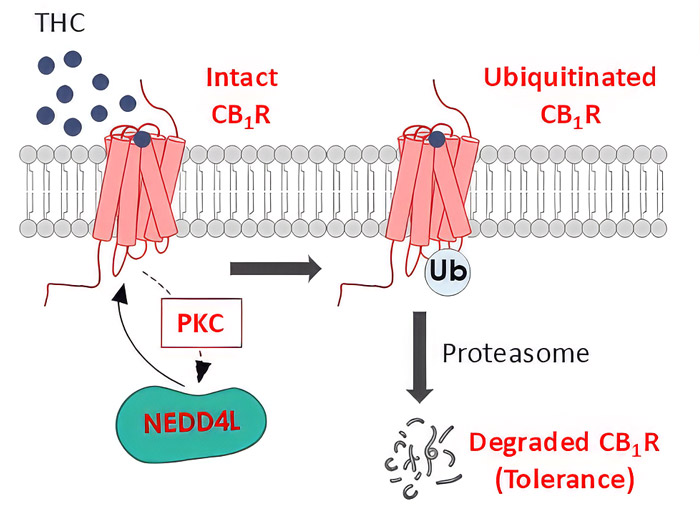
These findings reveal a molecular mechanism that controls CB1R levels and identify NEDD4L-mediated ubiquitination as a key factor in cannabinoid tolerance, a process that may contribute to cannabis use disorder (CUD) and to cannabis hyperemesis syndrome. Several epidemiological, clinical, and neuroimaging studies have linked chronic cannabis use with an eventual decrease in CB1R levels in the brain and the consequent emergence of tolerance. Since this process depends on the dose of THC, as well as the frequency and duration of consumption, it is more likely to occur in recreational users who consume high doses of cannabis continuously over a prolonged period. This causes these individuals to progressively increase their intake of the substance to achieve the desired effects and avoid withdrawal symptoms, thus increasing the risk of developing cannabis use disorder. Severe tolerance can also trigger cannabis hyperemesis syndrome, a chronic condition with increasing prevalence characterized by cyclical episodes of abdominal pain, nausea and severe vomiting, along with thermoregulatory disturbances.
The disorder is strongly associated with prior and repeated cannabis use and only resolves after cessation of substance use. It is believed that chronic exposure to cannabis desensitizes the central antiemetic mechanisms characteristic of cannabinoids, increases stress and interferes with thermoregulation, while the overstimulation that cannabinoids produce in peripheral tissues alters gastrointestinal motility through dysregulation of the enteric nervous system. Therefore, in a clinical setting, specific administration protocols are usually recommended, based on a slow increase in dose combined with low-dose regimens, aimed at allowing relief of symptoms without causing unwanted psychoactive effects and tolerance (the well-known motto of MacCallum and Russo: Start low, go slow).
In summary, in the current scenario of expanding recreational and medicinal cannabis use, this recent discovery by our group allows us to understand the mechanism of cannabinoid tolerance in greater detail and, more generally, provides new directions for exploring how the interconnection of CB1R with the ubiquitin-proteasome system may affect brain pathophysiology.
*Original article: https://doi.org/10.1073/pnas.2606671123
Álvaro-Blázquez, A., Rodrigues, R.S., Montero-Fernández, C., Isasa, M., Cannich, A., Gisquet, D., Rodríguez-Crespo, I., Bellocchio, L., Marsicano, G., Costas-Insua, C. & Guzmán, M. (2026) Cannabinoid tolerance relies on CB1 receptor ubiquitination by NEDD4L. Proc. Natl. Acad. Sci. USA. 123(35):e2606671123.